

I asked Claude Fable 5 to analyze NotifyWorld, find competitors and compare.
Here is what is says…
NotifyWorld sits at the intersection of three product categories — QR-tag lost & found, secure document vaults, and after-life/digital legacy sharing — so its competitors come from each of those angles.
NotifyWorld’s differentiation is bundling all three in one subscription with zero-access encryption — but that also means it fights on three fronts, against specialists that each do one piece more deeply.
Competitive matrix (features vs. pricing):
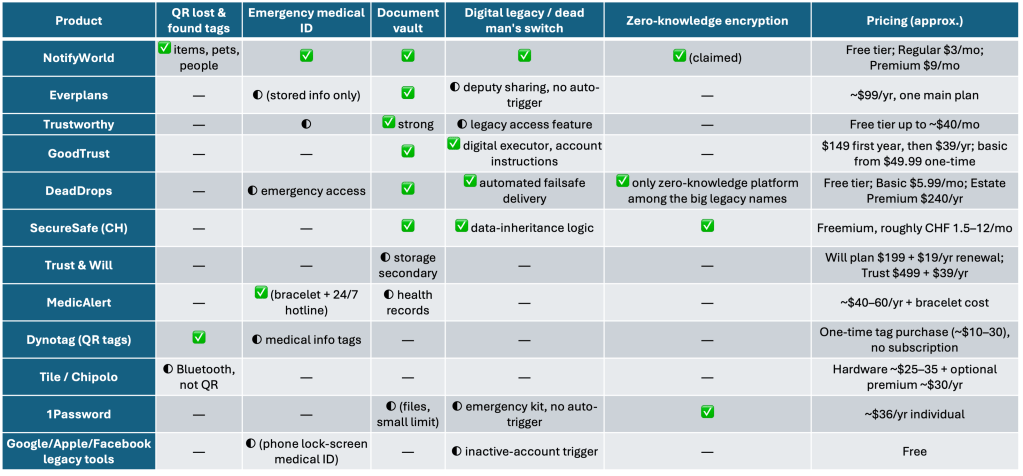
A few takeaways from the matrix:
Nobody else covers the full row. NotifyWorld is the only one with checkmarks across QR tags + medical ID + vault + legacy. That’s the pitch — but each column has a specialist that’s deeper: DeadDrops/SecureSafe on encrypted legacy delivery, MedicAlert on medical ID (with a human 24/7 hotline), Trustworthy on family document management.
Pricing pressure comes from two directions. From below: free tools (Google Inactive Account Manager, phone medical IDs, one-time QR tags) cover the “good enough” use cases. From above: Trustworthy and GoodTrust have marketing budgets and brand trust in the US market. NotifyWorld’s pricing needs to land between DeadDrops ($6/mo) and Trustworthy’s mid tiers to be competitive.
Zero-knowledge is the defensible column. Only DeadDrops, SecureSafe, and 1Password share it. Against Everplans/Trustworthy/GoodTrust — which use standard cloud encryption where the platform can access documents — that’s NotifyWorld’s strongest differentiator, and SecureSafe is arguably the most dangerous rival since it’s also Swiss and leads with the same privacy angle.
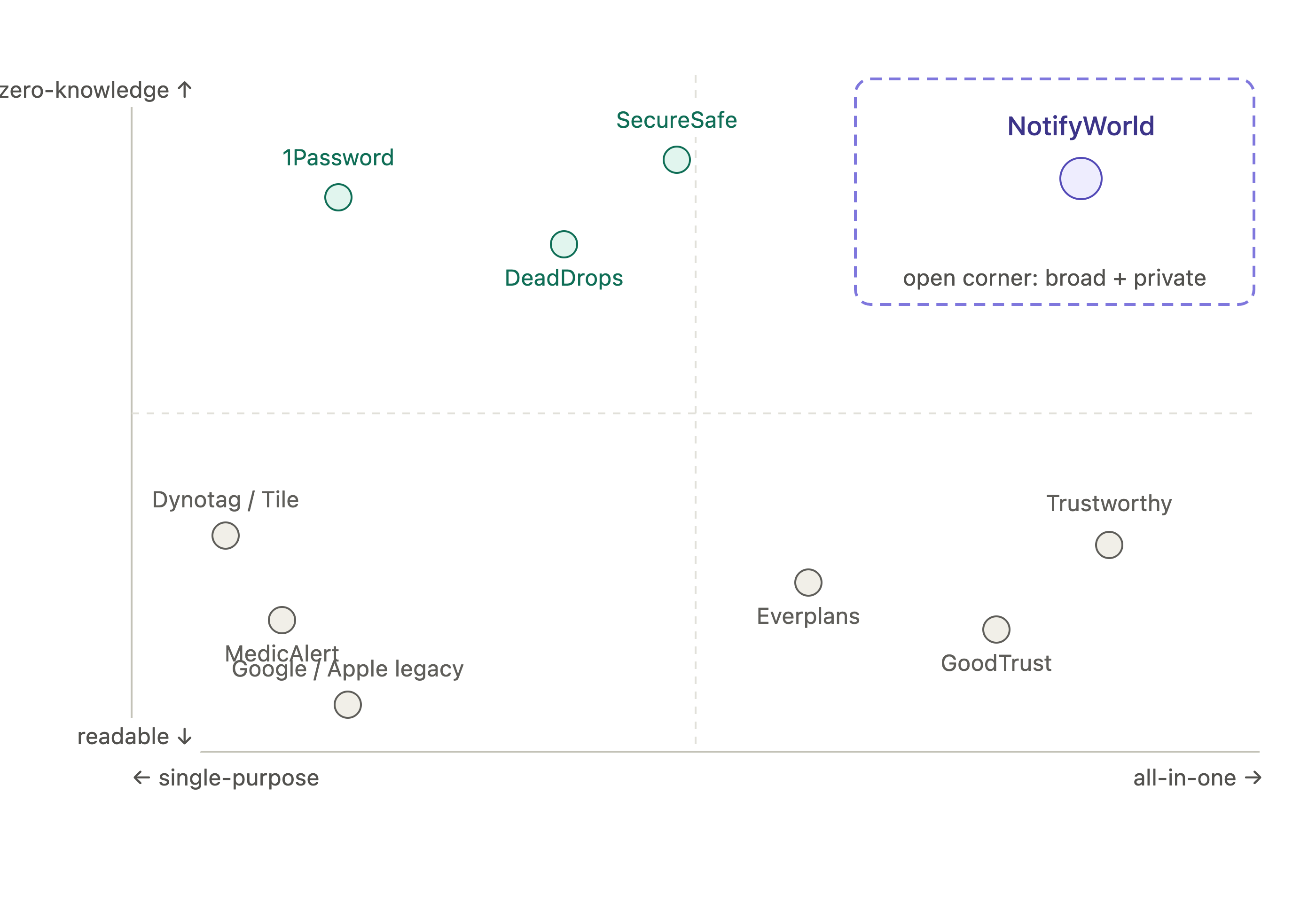
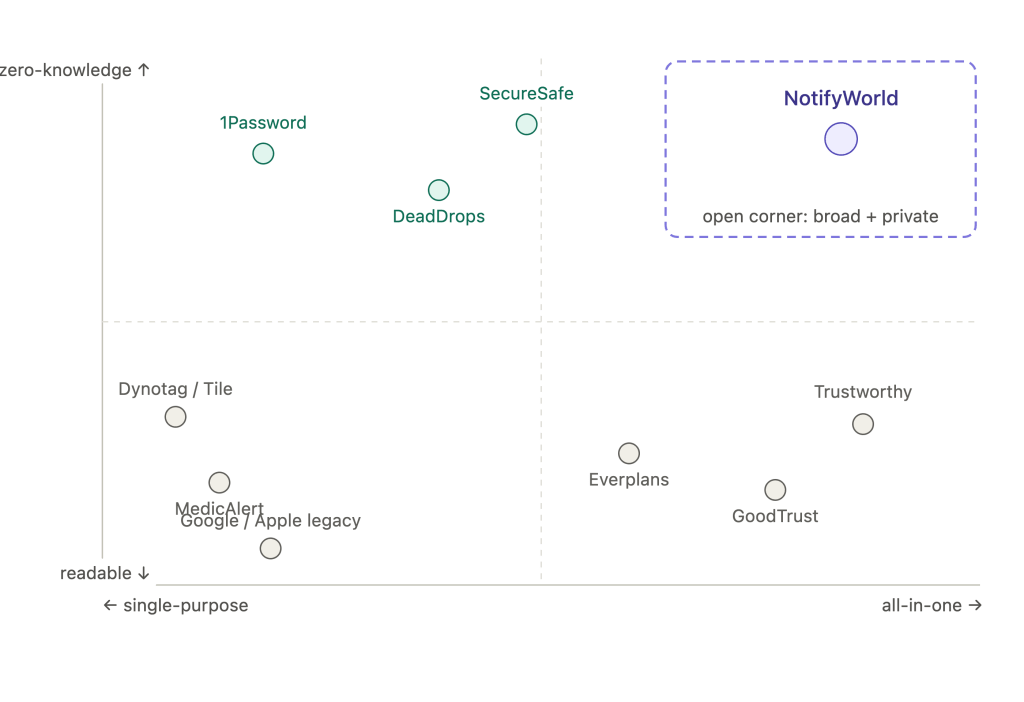
Here’s the positioning map first — the market splits cleanly along two axes: how much of the problem a product covers, and whether the provider can read your data.The top-right corner — broad coverage and zero-knowledge — is empty except for NotifyWorld. That’s the position to claim explicitly.
Three fronts, three different wedges
Against the broad incumbents (Trustworthy, Everplans, GoodTrust): attack on privacy. Their architecture lets the platform read your documents — a real objection for exactly the customer who’d store wills, medical data, and passwords. Message: “Would you hand your unlocked filing cabinet to a startup?” Secondary wedge: they’re purely digital. None of them helps when your dog runs off or you collapse on a hiking trail — NotifyWorld’s QR layer works in the physical world, offline, on a stranger’s phone with no app installed.
Against the privacy specialists (DeadDrops, SecureSafe, 1Password): don’t fight on encryption — match it and win on breadth and tangibility. These products are invisible until you die; NotifyWorld’s tags deliver value while you’re alive (found keys, recovered pet), which solves the classic retention problem of legacy apps — people churn from products they never touch. The tags are also a physical, giftable object, which digital vaults can’t replicate. SecureSafe deserves special attention as the Swiss privacy incumbent: differentiate on the physical layer and modern UX, since SecureSafe is essentially a vault with inheritance bolted on.
Against free tools and cheap hardware (Google/Apple legacy contacts, phone medical ID, Dynotag, Tile): don’t compete on price, compete on completeness and reliability. Free tools are fragmented across ecosystems, easy to misconfigure, and nobody’s job is to make sure they fire correctly. Position NotifyWorld as the “it actually works when it matters” bundle — one place, tested triggers, human-readable for whoever finds your tag.
Who to target first
Beachhead segments where all three features matter simultaneously, so the bundle beats any specialist: parents of young kids (tags on backpacks + guardianship documents + medical info), outdoor athletes and solo travelers (medical tag + emergency contacts + “if I don’t come back” vault), pet owners who also happen to be adults with affairs to organize, and expats — people living across borders with documents scattered in two countries and family far away. That last one fits the Swiss/European context well, since the US incumbents are weakly localized in Europe.
Risks
The empty quadrant might be empty for a reason. Classic strategy trap: an unoccupied position isn’t automatically an attractive one. It’s possible nobody bundles QR tags + vault + legacy because the buyers don’t overlap. The person buying a pet tag is in a $15, impulse, physical-goods mindset; the person doing estate planning is in a considered, trust-heavy, often advisor-mediated mindset. Bundling them may confuse both rather than delight either.
“Would you trust a startup with your unlocked filing cabinet?” cuts both ways. NotifyWorld is the unknown startup. For legacy products the buyer’s real fear isn’t just data access — it’s will this company exist in 20 years when I die? Everplans has been around since 2012; that dated interface is also 14 years of survival proof. A small player attacking incumbents on trust invites the response “and where will you be in a decade?” Mitigations exist (export guarantees, escrow of decryption instructions, open standards) but they need to be in the story, and they’re not yet.

 Nemanja Kostic